
To stay up to date on legislation and action alerts related to eating disorder care, join our mailing list.
To support our efforts, please use our donation form or contact us directly.
The documents below include more detailed information on the issues and our recommendations.
Update on Highmark Nutrition Policy
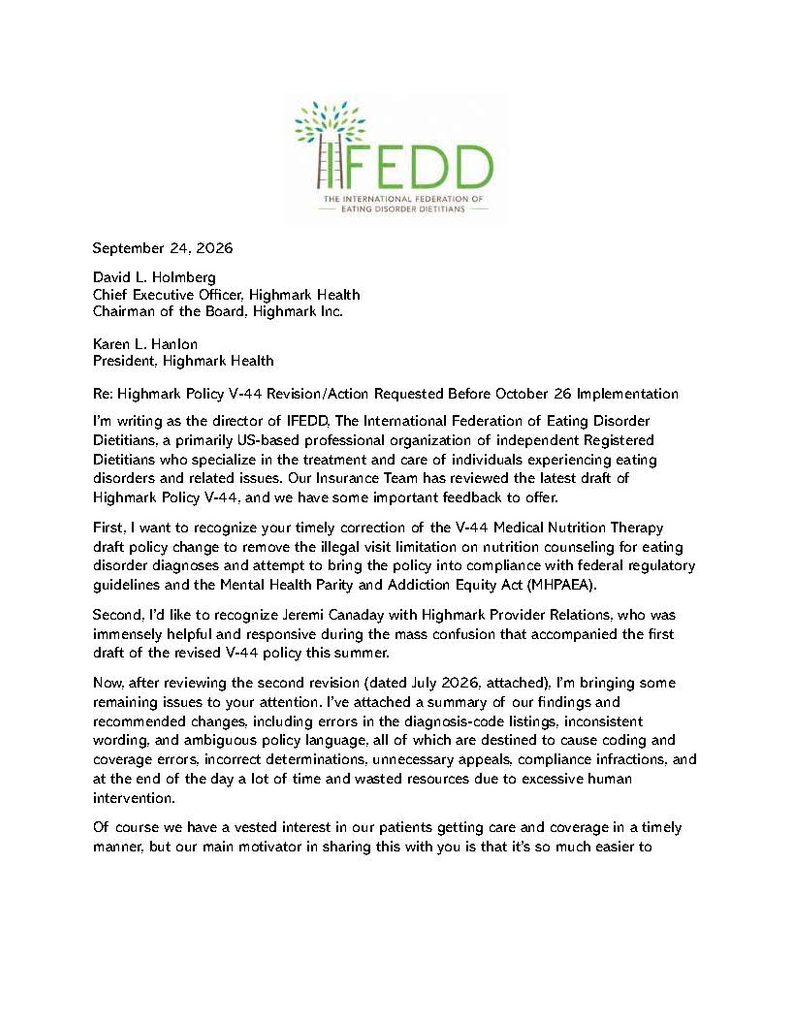
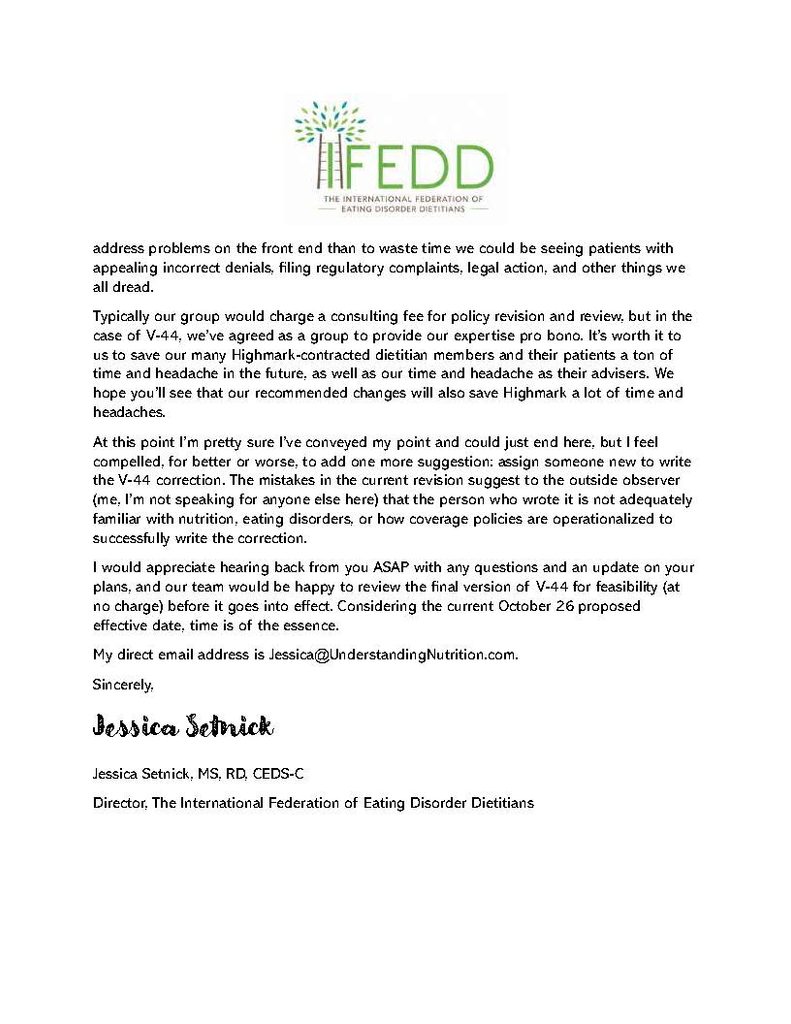
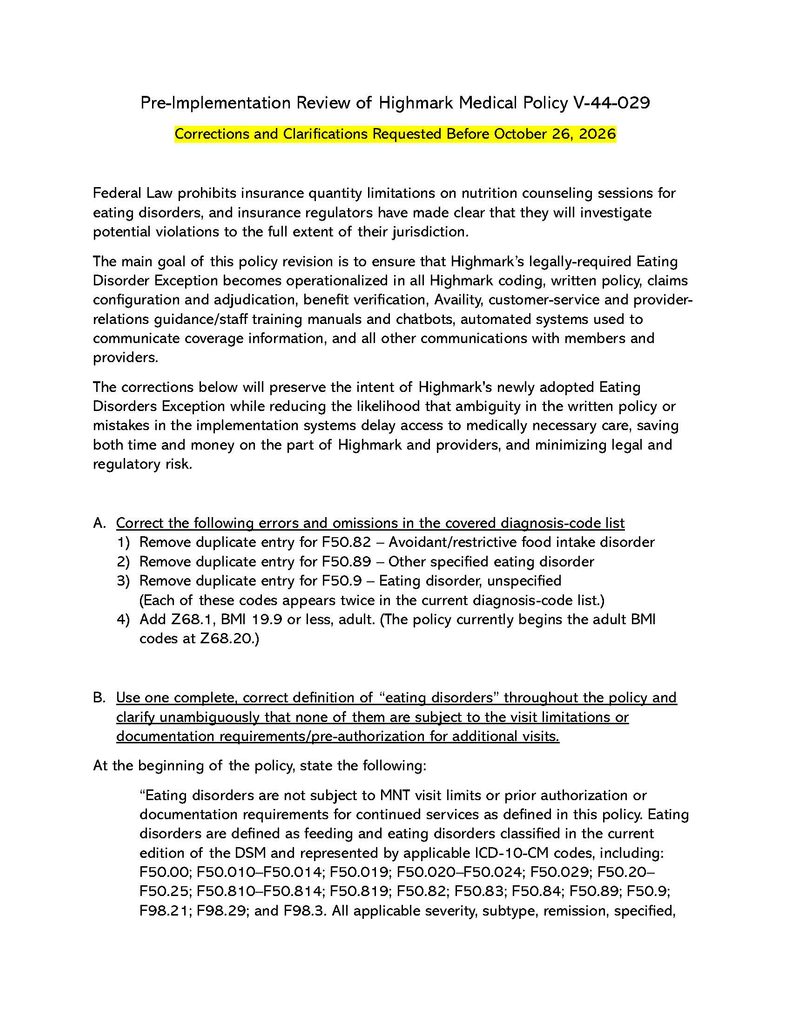
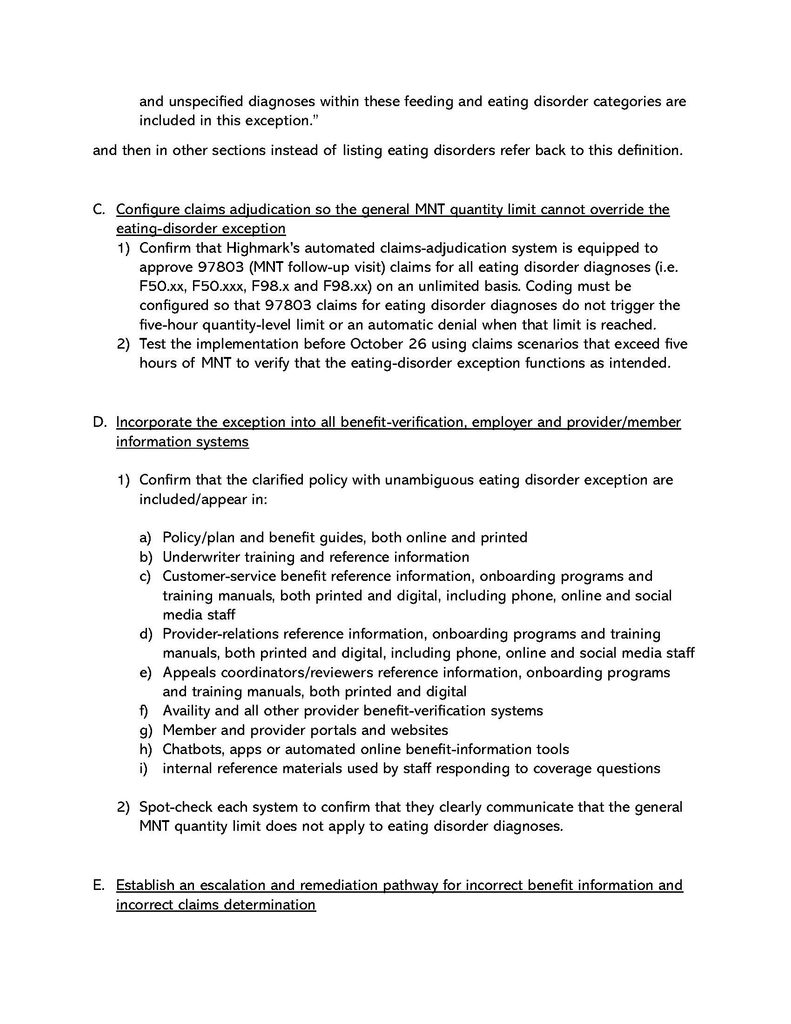
After IFEDD’s outreach (see Highmark Action Alert below), Highmark BCBS released a revised V-44 Medical Nutrition Therapy coverage policy (second document below) with an effective date of October 26, 2026. Although apparently revised with the intent to remove illegal limitations on nutrition counseling for eating disorders, the IFEDD Insurance Team determined that in actuality the revision contains errors and ambiguous language .
On September 24, 2026, IFEDD sent the following letter to Highmark President, Karen Hanlon, and Highmark CEO and Board Chairman, David Holmberg. Later that day, we received a reply from Highmark Chief Medical Officer, Tim Law, agreeing to review our corrections and suggested revisions (third document below).
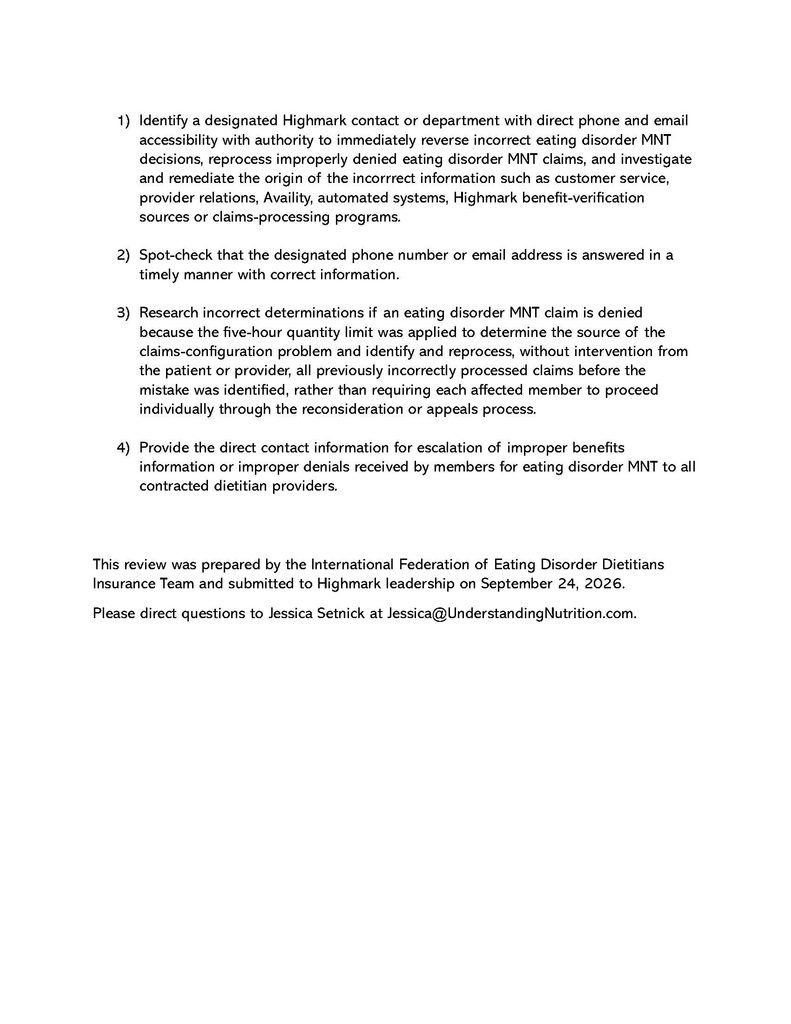
To our knowledge, Highmark BCBS policyholders have not received any notification about the upcoming policy change. Our team will maintain contact with Highmark BCBS leadership in hopes of a smooth policy transition and appropriate communication to the public. If you or one of your patients receives an improper denial of nutrition counseling for an eating disorder diagnosis, please alert the IFEDD Insurance Team at CARE@IFEDD.org.
Blue Shield California Update
In 2024, IFEDD’s Access to Care program helped IFEDD members and patients file complaints with California regulators related to improper denials of eating disorder MNT by Blue Shield of California. This week, those regulators fined Blue Shield of California $800,000 and required corrective action after finding repeated delays and incomplete responses during investigations of these and other complaints. The more times regulators hold insurers to account, the more we can encourage other insurers to handle appeals correctly and speedily from the beginning. IFEDD encourages anyone filing insurance appeals to document all communications, track deadlines, and maintain a clear record of denials, delays, and failures to respond. For a downloadable Communication Log, visit IFEDD’s Help with Insurance Denials page here: https://ifedd.org/help-with-insurance-denials.
Blue Cross Blue Shield of Michigan
Highmark Action Alert – June 30, 2026
Requesting your help putting public pressure on Highmark Blue Cross. The company has a new rule that limits nutrition counseling to 5 visits per year regardless of diagnosis. They say they are doing this because they don’t have evidence that nutrition counseling beyond 5 visits is helpful. They are wrong. There are so many things wrong with this policy and we are addressing it from several different angles. You can help.
Please email Jeremi.Canaday@highmarkhealth.org today.
Don’t overthink it – this doesn’t have to be a formal letter of any kind. The goal is mass public outrage. Your email can be as simple as one line about what you thought when you heard about this rule, such as:
- Your personal thoughts about why this limit is not okay for people with eating disorders and other conditions
- Your personal experience with nutrition counseling for your/your family member’s eating disorder
- Why it’s not okay for an insurance company to pick a random limit for medical care
Here are some ideas if you need one:
- Five nutrition counseling visits are not enough for a person with an eating disorder.
- Multiple independent medical organizations recommend no less than weekly nutrition counseling in the early treatment stages of an eating disorder.
- Limiting eating disorder nutrition therapy to five visits falls well below the standard of care for eating disorder treatment and places recovery at risk.
- A five-visit cap on nutrition counseling for eating disorders is inconsistent with the clinical needs of patients and accepted treatment standards.
- Restricting nutrition counseling to only five visits for eating disorder treatment creates an arbitrary barrier to medically necessary care.
- Five nutrition counseling visits may be appropriate for a short-term nutrition concern, but they are not an adequate course of treatment for a serious mental health condition such as an eating disorder.
- Arbitrarily limiting eating disorder nutrition counseling to five visits is inconsistent with accepted standards of care.
Please share the link to this page with anyone you know who cares about eating disorders: https://ifedd.org/advocacy. Anyone can participate, it is not necessary to be a Highmark customer.
If you would like more background, details and documentation are provided below. It is not necessary to read them before sending an email. The email is the main thing. THANK YOU.
Note that the policy, in writing, states that after the 5 nutrition sessions, your dietitian can request more visits but they will be automatically denied and sent to a peer-to-peer review, which if denied again will be the final word with no further option for appeal.
On May 26, 2026 Highmark BCBS covering multi-thousands of people in NY, PA, WV, and DE updated their policy stating August 24, 2026 all nutrition counseling/Medical Nutrition Therapy for any condition will be limited to 5 visits per year.
On June 29, 2026 in response to clarifying questions they gave this official response:
Update on DSM Severity Criteria: Approved!
Update May 28, 2026: In response to IFEDD’s proposal submitted in October 2024 and after reviewing the comments submitted during the public comment period, The APA Assembly has approved the “corrected” severity criteria for anorexia nervosa, bulimia nervosa and binge-eating disorder as follows:
- Mild: Few, if any, symptoms in excess of those required to make the diagnosis are present and symptoms and illness-related medical complications result in no more than minor impairment in social or occupational functioning.
- Moderate: Symptoms, functional impairment, and illness-related medical complications between “mild” and “severe” are present.
- Severe: Many symptoms in excess of those required to make the diagnosis, or several symptoms that are particularly severe, are present, or the symptoms result in marked impairment in social or occupational functioning or in serious and potentially life-threatening illness-related medical complications.
For more information on the background that prompted this correction, see “Proposal to the American Psychiatric Association: Revert Diagnosis “Severity” Specifiers Back to Discretionary Status by the Provider” lower down on this page.
IFEDD’s Press Release about the announcement is below:
California Bill to Ban Diet Pill Sales to Minors
***Update: Bill AB 2030 passed the California Senate the week of August 28, 2026 and will now go to Governor Newsom’s desk.***
Bill AB 2030 will disallow sale of diet pills and “muscle-building” supplements to anyone under 18.
The submission portal is open now for California residents, providers, and organizations with constituents in California to submit a letter or written statement in support of the bill.
First write your opinion and save as a PDF. It can be in letter format but doesn’t have to be.
You can write about your own experience personally or professionally with the harms of “weight-loss” and “muscle-building” supplements, especially for teens, or consider including one or more of the following points:
- Diet pills and “muscle-building” supplements are not pre-screened by the FDA before they are sold, leaving minors vulnerable to products that may contain banned drugs, toxic chemicals, steroids, or heavy metals.
- These products contribute to more than 23,000 emergency department visits each year in the United States.
- Youth who use diet pills or “muscle-building” supplements experience severe medical injuries at triple the rate of those using ordinary vitamins.
- Teens who use over-the-counter diet pills are six times more likely to develop an eating disorder within 1–3 years.
- Teens who use muscle-building supplements are eight times more likely to go on to using steroids.
- Serious organ damage, including liver failure, has repeatedly been linked to these supplements.
- Aggressive marketing practices often target adolescents through social media, increasing risk during a vulnerable developmental period.
- Major medical organizations, including the American Academy of Pediatrics, caution strongly against teen use of these products.
- AB 2030 would create a common-sense safeguard by restricting the sale of diet pills and “muscle-building” supplements to individuals under 18, helping protect California youth from products linked to serious health harms.
Once you have your letter/statement ready:
- Register for an account at this link: https://calegislation.lc.ca.gov/Advocates/faces/index.xhtml
- Once you receive the confirmation email, sign in and click on “Submit a letter”
- Select AB and type in 2030
- Choose Regular session type
- Click Next
- Click Next – Select File
- For Stance, click Support. For Subject, type Support for AB2030 or your choice of title.
- Select your file, click Submit.
IFEDD’s letter in support of California Bill AB 2030 is below:
Nebraska Bill to Cover Eating Disorder Care
On February 24, 2026, Nebraska Legislature’s Banking, Commerce and Insurance Committee will consider moving forward bill LB780, which requires all health insurance operating in the state to cover eating disorder care.
IFEDD has submitted the following statement and encourages anyone with a connection to Nebraska to do the same. The number of submissions is important even if not all of the comments are read by the committee.
Nebraska residents or providers, and organizations such as treatment facilities or advocacy organizations that represent Nebraskans may submit comments of up to 500 words here before February 24, 2026 at 8 a.m.
Submissions may be as brief as “I support LB780 and eating disorder care for Nebraskans.”
Check that you are a PROPONENT of the bill and select 0 for your district if you do not live in Nebraska.
Note that you will receive an email and you have to click the link in the email to submit your comment.
If you would like to write more, introduce yourself and your relationship to eating disorder care, whether personal or professional or both, state your position in support of the bill, and whatever you feel comfortable sharing about your personal experience with insurance denials of coverage for eating disorder care.
Submit at this link before 8 a.m. on February 24, 2026. https://nebraskalegislature.gov/bills/add_statement.php
Update on DSM Severity Criteria: Public Comment Period
Update January 8, 2026: The public comment period for this initiative has closed. This page was accessed 2800 times during the public comment period. Thank you for your participation in this initiative. Any updates will be posted here when received.
In response to IFEDD’s proposal submitted in October 2024, The American Psychiatric Association has released a Correction to the Severity Specifiers of Eating Disorders (Anorexia Nervosa, Bulimia Nervosa, and Binge-Eating Disorder). Per APA procedure, the recommended new guidelines are currently available for public comment before going to the APA Assembly and Board of Trustees for a final vote of approval.
We encourage everyone in the eating disorder community, including treatment providers, affected and recovering individuals, family members, caregivers, advocates, and organizations to submit at least one comment in support of the new criteria before the comment period closes on January 8, 2026. Estimated time to complete: 1 minute.
Why does IFEDD support the new criteria?
Although there are still many recognized problems with the DSM eating disorder criteria as a whole, IFEDD supports this particular change. Previous criteria used only one unrelated factor – BMI for anorexia nervosa, number of binge episodes per week for binge eating disorder, or number of binge/purge episodes per week for bulimia nervosa – to determine severity of an affected person’s condition, rather than the wide range of observed and experienced factors that contribute.
The new severity criteria are the same for all three named eating disorders and respect the diagnosing provider’s clinical judgment:
- Mild: Few, if any, symptoms in excess of those required to make the diagnosis are present and symptoms and illness-related medical complications result in no more than minor impairment in social or occupational functioning.
- Moderate: Symptoms, functional impairment, and illness-related medical complications between “mild” and “severe” are present.
- Severe: Many symptoms in excess of those required to make the diagnosis, or several symptoms that are particularly severe, are present, or the symptoms result in marked impairment in social or occupational functioning or in serious and potentially life-threatening illness-related medical complications.
If you’re ready to submit your comment, click here: https://tinyurl.com/SeverityCriteriaComment
There is no option to submit your comment anonymously, so if you prefer not to give your name and email address, please send your comment here: info@eddietitians.com and we will submit it anonymously for you.
If you’re unsure what to say, here are some possibilities to choose from. You can also write your own comment and/or share your personal experience.
- These changes move the field closer to clinical reality. Symptom severity and functional impairment have always been more meaningful than BMI or episode counts when assessing risk.
- The new criteria using medical complications acknowledge what providers see every day: severity cannot be captured by numbers alone.
- This update allows clinicians to document the true level of impairment and risk of each patient.
- The shift away from BMI-based specifiers is long overdue. BMI has always been a poor proxy for illness severity, and this proposal reflects the current evidence base.
- Emphasizing functional impairment highlights the fallout that eating disorders cause in all areas of life—factors that often determine safety far more than weight or episode count—and providers can still use extremes of BMI or binge/purge frequency in decision-making if they wish.
- This correction better captures the complexity of eating-disorder presentations and makes space for individualized clinical judgment, a glaring omission from the previous specifiers.
- The recognition that compensatory-behavior frequency or binge frequency alone cannot fully describe severity represents meaningful progress in diagnosing eating disorders.
- These revisions strengthen the diagnostic framework and may help reduce misclassification, particularly in individuals whose medical risk is not reflected in current specifier thresholds.
- A more nuanced severity structure will improve access to care and hopefully patient and family willingness to seek help.
- The new criteria give clinicians more accurate language to explain to patients and families the severity of their illness.
- These changes finally recognize that eating-disorder severity is about medical risk and functional impairment—not numbers on a scale or behavior tallies. This is a major step out of the dark ages.
- The change means diagnostic language will better reflect the true danger of eating disorders.
- Prioritizing medical complications and functional decline means that doctors may now be better listeners to patients who “don’t look sick.”
- The old standards were arbitrary and had no basis in evidence-based care. In fact they made the APA seem out of date and passé.
- Aligning severity with real-world clinical risk makes the DSM more ethical, more patient-centered, and less dependent on outdated assumptions.
- Recognizing severity through multiple domains will lead to better assessment, earlier diagnosis, and more proactive treatment planning, ideally lowering treatment costs due to earlier intervention, shorter stays, and lower relapse rates.
- Parents of medically vulnerable children who didn’t meet the previous numeric criteria are breathing a sigh of relief that their child’s suffering will no longer be ignored.
- This shift toward multidimensional severity specifiers is a win for the recognition that eating disorders are complex and need treaters with expertise.
- These improved severity specifiers reflect what we see in practice—risk is multifactorial, and BMI or behavior frequency alone has never captured the full clinical picture.
- I appreciate that the revision allows for increased severity based on medical instability. This better aligns diagnostic coding with treatment needs.
If you’d like to use references in your comment, there are many cited in the original proposal (below), and Millie Plotkin has compiled this list of relevant articles published since the proposal was submitted: https://docs.google.com/spreadsheets/d/13o_g5jBXUvNle3_6FXea_wrIIvyNarM9ZDfosR1556A/edit?usp=sharing
For more information on the background that prompted this correction, see “Proposal to the American Psychiatric Association: Revert Diagnosis “Severity” Specifiers Back to Discretionary Status by the Provider” lower down on this page.
Please share this information with your colleagues and other members of your family and organizations, on social media and in any online groups, and encourage them to submit a comment. The direct link to this page is https://ifedd.org/advocacy and you can screenshot this graphic to post along with the link.
Sample Caption:
In one minute, you can make a difference! Tell the APA you support correct diagnosis of eating disorders.
All information at www.IFEDD.org/advocacy
To read the APA announcement, click here: https://www.psychiatry.org/psychiatrists/practice/dsm/proposed-changes
IFEDD’s Press Release about the announcement is below.
Please share widely and direct any questions to info@eddietitians.com.
Proposal to the American Psychiatric Association: Revert Diagnosis “Severity” Specifiers Back to Discretionary Status by the Provider October 2024
Request to the Secretary of Veteran’s Affairs: Allow Dietitians to Continue Remote Work if Needed to Assure Patient Safety and Confidentiality April 2025
Documentation of Concerns Regarding Eating Disorder MNT Claims Presented to Federal Regulators of the Mental Health Parity and Addiction Equity (MHPAEA) Proposed Rule Clarification July 2024
IFEDD’s Comment on the Mental Health Parity and Addiction Equity (MHPAEA) Proposed Rule Clarification Submitted October 2023
The text of the MHPAEA Clarification Rule, i.e. the full proposal of revised regulations, can be accessed here: https://www.federalregister.gov/documents/2023/08/03/2023-15945/requirements-related-to-the-mental-health-parity-and-addiction-equity-act .
The Nutrition CARE Act
Nutrition Counseling Aiding Recovery for Eating Disorders Act of 2023, also known as The Nutrition CARE Act, would fix a gap in Medicare Part B coverage, which excludes individuals with eating disorders from receiving Medical Nutrition Therapy. Currently, Medicare doesn’t cover members for meetings with their dietitian. This also applies to individuals with Social Security Disability.
To learn more, view the Eating Disorder Coalition’s Nutrition CARE Act infographic.
The full text of The Nutrition CARE Act can be accessed here: https://www.congress.gov/bill/118th-congress/senate-bill/3010/text.
To be aware of action alerts related to The Nutrition CARE Act, join our mailing list.
The Eating Disorder Coalition’s Advocacy Day on Capitol Hill
Every year, IFEDD sends member delegates to The Eating Disorder Coalition’s Advocacy Day. Delegates meet with US Congressional staffers who directly influence legislation. In 2024, Advocacy Day once again returned to in-person meetings, and 11 IFEDD members from as far away as California and Alaska gathered in Washington, DC, to participate.
Our Advocacy Mission: Access to Eating Disorder Care
IFEDD was founded with the specific goal of improving access to nutrition services for individuals with eating disorders. By gathering eating disorder dietitians in a way that had never been done before, IFEDD has been able to demonstrate that illegal insurance discrimination against individuals with eating disorders is rampant throughout the US and not limited to any one company, location, provider or patient.
There seems to be no incentive for insurers to follow the law because there is no enforcement. We continue to work through multiple channels to help individuals get coverage and to encourage insurers to solve the problems internally before regulators and legislators get involved.
If you lead an insurance company and would like to know if you are part of the problem, please contact CARE@IFEDD.org.
If you are personally experiencing insurance discrimination and would like help, please see our Help with Insurance Denials page or email CARE@IFEDD.org.
