

What is your specialty?
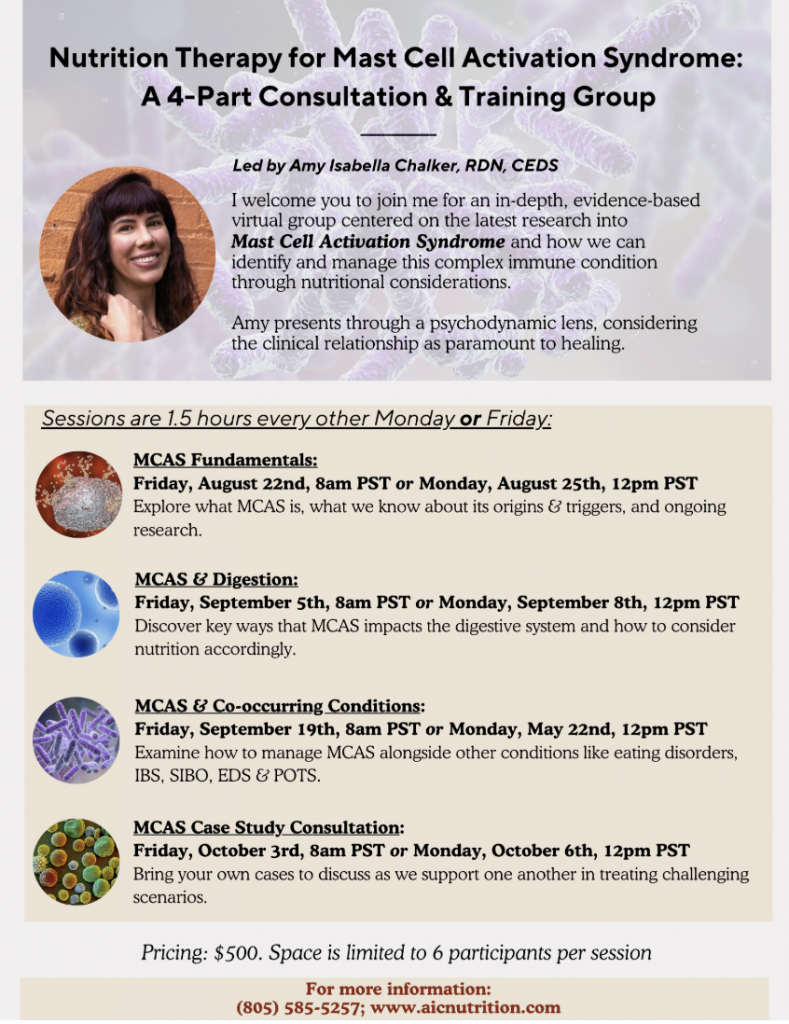
I am an eating disorder dietitian who specializes in co-occurring digestive issues and other chronic health conditions such as Irritable Bowel Syndrome (IBS), and Mast Cell Activation Syndrome (MCAS). One of the most common GI issues I see is small intestinal bacterial overgrowth (SIBO) when bacteria from the large intestine migrate to the small intestine, causing bloating, discomfort, and pain, among other possible symptoms. It can be treated with antibiotics, but managing the symptoms of the pain requires a lot of dietary finesse.
My goal is to help clients restore gut health and emotional well-being through food, using supplement protocols when appropriate, and to help them manage their symptoms while dealing with an eating disorder or disordered eating.
There is a synergistic relationship between eating disorders and GI conditions. Restrictive eating disorders in particular can be a trigger or a catalyst for MCAS, IBS, and other GI conditions. With respect to MCAS for instance, starving mast cells are activated mast cells, and once immune cells and other GI cells are activated, they can become inflamed and unpredictable. The opposite can also be true, when a GI condition precipitates disordered eating. I see this frequently when clients tell me they aren’t able to eat the same foods they used to eat.
How did you find your niche?
I’ve been a dietitian for almost 20 years, and I’ve also owned a gourmet food shop, ran a beverage company, been a massage therapist, and worked in a lot of other roles outside of dietetics. I returned to private practice dietetics in 2017, and I knew I wanted to work with the ED population. During this time, I noticed how often GI issues showed up at my practice and as someone with a history of my own GI issues, I know how debilitating it can be. I saw again the strong link between GI issues and eating disorders when I’d meet with a client about their eating disorder, and stomach pain, bloating, body image, and/or pain would come up in the conversation. I quickly realized that I couldn’t talk about EDs without talking about physical repercussions, even if they didn’t translate to full blown GI disorders. GI issues are almost always present during recovery.
My interest developed organically, but certainly accelerated during the COVID-19 pandemic. COVID has driven the rates of these GI issues much higher. Post-covid, many patients were getting diagnosed with MCAS and other related GI conditions. My niche became a necessity, and I started to become really passionate about it, due to so much ongoing research but few conclusions and even fewer resources for patients. My advice for other clinicians would be to find a niche that is in demand and that you’re passionate about. That is one way to make the most impact both personally and professionally.
What advice would you give to a student who wants to work in a similar role as you?
My biggest advice would be to find a supervisor or mentor. When I first became interested in GI issues, I did a lot of training with physicians, therapists, and RDs who were already experienced in these areas. I have also been under the consultation of an eating disorder therapist for many years, which has taught me how to view treatment through a psychodynamic lens. If you are currently a student, you can start by reading peer-reviewed research articles; there is a lot of information about gut health, the microbiome, and the interplay between the gut-brain connection. Staying up to date on the latest evidence will be essential to becoming an effective clinician, given the rapidly changing field.
You also practice through a psychodynamic lens. What does that mean?
I was trained by a psychoanalytic/psychodynamic eating disorder therapist, and I’ve also done ongoing continuing education through the Center for Modern Psychoanalytic Studies and the Academy of Clinical and Applied Psychoanalysis. It has heavily influenced the way I approach eating disorders. A psychodynamic lens takes into account unconscious experiences that are going on under the surface. For example, if a client is having significant GI symptoms but for months they keep forgetting to schedule an appointment with a GI specialist, it may suggest a deeper resistance at play. I would bring my concerns up to the patient using our clinical relationship as fodder to help them work through it, along with their therapist. Viewing eating disorders through a psychodynamic lens is key to addressing some of the root causes and drivers of the condition, rather than just the symptoms.
How did you get your name out there as someone who has this specialty?
I’ve done a lot of experimentation to figure this out. I did a lot of work on SEO (search engine optimization), writing blogs, listing myself in various directories for MCAS, Ehlers-Danlos Syndrome, eating disorders, and doing interviews to help build my reputation. I also love to network with other clinicians through trainings and workshops and word of mouth. After some time, I noticed a big difference and clients had a much easier time finding me.
